Battle of Panipat 1761

Battle of Panipat 1761

Pages

Monday, February 29, 2016

Raviwar Peth Pune


Raivwar Peth
 Pune


A walk through the lanes of Raviwar Peth.

Darpana Athale and Vaibhavi Agarwal of Pune Walks, proposed this trip. I was in two minds about going, wondering what architecture we would find there. A mention of structures around 200 years old and I readily signed up for the walk.

Raviwar Peth at first glance is a maze of lanes and by lanes. The deeper you go, the more chances of you getting lost...or so I thought...


Going back into history, Pune was once known as Kasba and the Kasba Peth of today was a residential area, trade was carried out outside the Kasba. With the increase in commerce, traders from different regions came and settled on the outskirts of the kasba. These traders opened their shops and built their houses on top of the shops. Raviwar Peth boasts of being in existence since the 1600's.
The houses they built have a peculiar style. As shown in the photographs below, they are linear, that is they were narrow at the entrance and deep inside.


The shop is on the ground floor. The first floor is a meeting place to conduct business. the second and or third floor is the residence. Most of these structures open on to the road.
The area of Raviwar peth extends towards Shukrawar, Somwar and Budhwar peth. A Peth means a Bazaar or Market. So essentially all these peths are market areas.
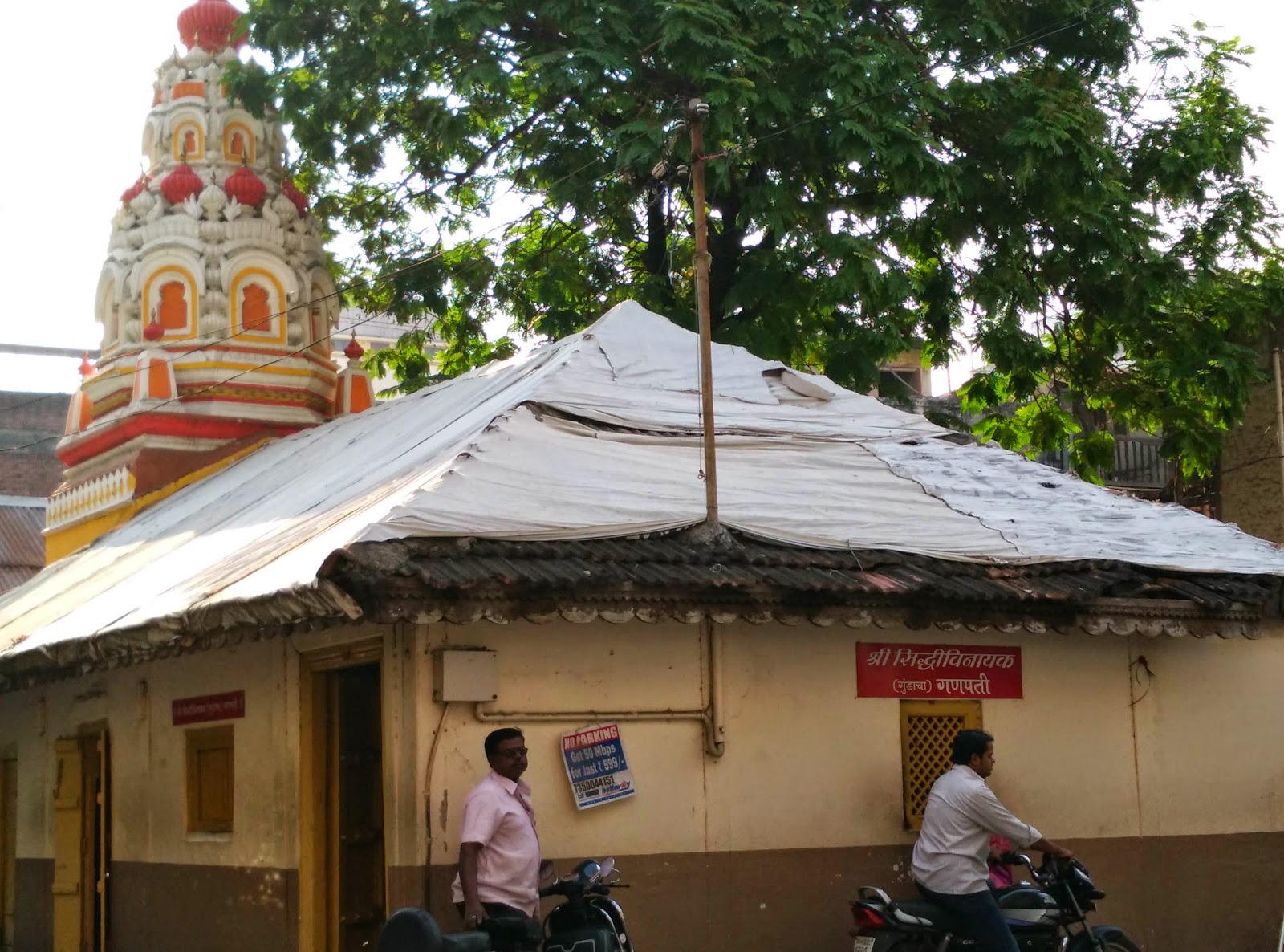
Raviwar Peth is a wholesale market. It is divided into many parts. Each part boasts of a different trade. At the end of each part there is a temple almost like a demarcation point for the end and a beginning of a particular trade. Also some ancient masjids are seen here.
Raviwar Peth was known as Malkapur in the 16 and 1700's. Adilshahi, Nizamshahi, Shahaji Raje Bhosle, the Peshwa's and the British rule, has added a certain mix of Architecture and the business conducted here.
It is during the Peshwa rule that Raviwar Peth, as it came to be known, thrived as an affluent business centre.
Traders from different communities such as the Bohri's, Marwari's, Gujrathi's, Maharashtrians all came and set up their shops here. Living in perfect harmony, as they still do, we find remnants of their culture in their shops and living styles.
From hardware, Jewellery, Perfumes, Metal ware, Utensils etc. can be seen here. The names of the lanes or galli, in the Peth denote each area. There is Bhandi galli, Sugandhi Katta, Sarafa galli etc.


The Yevlekar and Dantale jewellers have been here since the 1800's. All jewellery in Gold, precious and semi precious stones was hand made. Infact today there is  only one Octogenarian gentleman, Mr. Bahulikar, who still makes hand made jewellery. This art will disappear unless it is revived again soon. Today all jewellery is mostly machine made.

Façades of buildings, some of which retain their original form, crumbling buildings with a few arches that remain intact tell us of the different types of architecture over the passage of time.
Here we find balconies, arches and windows, showcasing, art and architecture of the Mughal, Peshwa, Rajasthani and Colonial eras.


There are canopies and balustrades, intricately worked railings of balconies, in iron, cement and wood, crying out for attention.

Demolition work was being carried out to one of the structures and we could see the brick work, very different from what we see today. The bricks are square with a narrow width.These were known as 'Pustaki Veet', a brick shaped like a hard cover book. One such building had the year 1947 carved on it.


There are façades with a painted clock. Sadly the paint, has started peeling off through the ravages of time.
Most of these buildings today are in a dilapidated condition. With no maintenance and expensive to restore, they are either going to fall down or get demolished. Some of them, like the one shown below fall under the Development Plan of Pune and may be torn down.


New Modern Buildings will take their place. Box like structures with no grace or art will come up. This skyline is already mushrooming and the contrast is stark. Unfortunately in the coming decade these cement blocks will be our heritage.
It is heartening to see that students from VKPS College Of Architecture and MITID Architecture College are documenting these ancient structures for posterity.
The meticulous planning and execution of structures and the lanes of the 17th and 18th C., puts this haphazard and unplanned neo construction to shame. 
It is my personal opinion that each one of us should visit all the lanes and by lanes of our cities. The least we can do is to capture this legacy for the coming generations before it is too late.


Tuesday, August 4, 2015

Water Resources In the Peshwa Era.

Water supply to Pune and Maharashtra


The Period....around 1740.

The city of Pune was growing. New settlements started coming up around the Mula river. "Peths" as they are known, grew, as the city prospered. With an increase in population came the demand for water supply.


Till Pune was a small settlement most of the housing was near the river and shortage of water was not a source of worry. As it grew, habitation went away from the river. This brought in the problem of sourcing of water for daily needs.


This became obvious in 1745. The absence of rain created a drought situation in Pune. However the orchards and gardens were still watered by bringing cartloads of water from the existing rivulets and wells. Nanasaheb Peshwa was at Satara and Radhabai his grand mother at Shaniwarwada. There is a letter from her to Nanasaheb which states " I am really worried for the people of Pune. It is not right that trees and gardens receive water but the citizens are dying of thirst. Immediate stop should be put on this. Trees as they are well rooted can survive but people cannot." It had the desired effect and a plan to build a systematic supply of water to Pune was to put to effect.

In those times there was no piped and tapped water to the households. The Mughals, brought in the idea of digging wells. These wells were for the general public and free of taxation. Also in ancient times, small lakes or ponds were dug and because it was impossible to carry water to the households, canals were dug and the water channeled . This way the water could be used not only for the house but also in the backyard.

The Peshwa's followed this up too. The Maratha's during their war campaigns, had seen these kind of lakes and ponds in Mysore and Chennai (Madras of yore). The Peshwa's with the help of their Generals and Chieftains, built many such lakes and ponds around Pune and Maharashtra.

BajiraoI built 2 such lakes. One at the bottom of Dive ghat and the other at Katraj. The lake at Katraj was built to bring water into Shaniwarwada and around it.
During Nansaheb Peshwa's time, Nana Phadnavis, continued with the work. Narhe Ambegaon is a village around 7.5 kms from Pune. Narhe means a rivulet or canal. Pipes were made with lime and mud and water was brought into Sadashiv Peth from the lake in the village.
Similar tanks were built in many parts of Pune . Even then it was seen that the benefit of these resources could only be availed by a few hundred households. Thus, Nanasaheb Peshwa ordered the construction of a lake at the foot of the Parvati Hill in Pune in 1745. A note of the time said that as it was summer there were guava fruit orchards in the area. hence digging began in areas where natural springs were revealed. Once the construction of the lake was completed, areas which felt the water shortage received water. New settlements came up and the whole area turned green.

Bajirao II, built another tank in Vishrambaug wada and the water for this too came from  Narhe Ambegaon.

To the south of Pune, around 7.5 kms away, lies Kondhwa. Sardar Raste, through the same system of pipelines brought water from here into Rastewada and Rasta Peth.

Not only in Pune, but all over Maharashtra such methods were used to bring in a regular water supply.

Pune and Satara, being the capitals of power, both Shahu Maharaj and the Peshwa, made sure that adequate supply of water was provided to Pune and Satara.

In the same way the Sardars and Chieftains of villages built tanks and dug wells, bringing in water to the villages.

Villages close to the rivers Krishna, Godavari, Pravara, Bheema, Koyna, and Indrayani, never fell short. The  realisation of the availability of ground water even away from the rivers was taken up and followed. In addition to the Sardars and Chieftains, there were magnanimous and philanthropic citizens who funded the projects. Saints too were known to fund and help build and bring water supply to remote areas. A special mention has to be made of Brahmendra Swami. The Guru of both Shahu Maharaj and the Peshwas, he took it upon himself to construct many tanks, lakes and wells. Drought prone places like Indapur, Natepute, Yavat, Malshiras etc benefited from these well laid out schemes.
There were other good doers too who helped with whatever they could afford. They would take manual and sometimes a little monetary help from the villagers. If they could not muster enough funds, an appeal was made to the government and funds were released to complete the projects.It is to be noted that all such supply was free of cost not only to the villagers but also to travellers and herdsmen.

Once a tank or lake was constructed, it was the responsibility of the village to keep it clean. Most of the time this time responsibility was fulfilled satisfactorily. At times due to various reasons, for example, people washing themselves while coming back from the fields, herdsmen and people coming to wash their clothes and vegetables etc., the villagers could not handle the task. At such times again a plea for help would be requested. A guard would ensure that these water bodies were kept clean.

During Sawai Madhavrao"s reign, Ghashiram Kotwal was the head (Kotwal). He constructed a tank to the North of Hadapsar  to facilitate travellers and herdsman's needs. He built orchards in this area too. During summers when the tank would run dry, he built pipelines and brought water from the stream in Kondhwa Budruk to the tank.
 The basic necessities of the villagers and town folk were of paramount importance to Shahu Maharaj and the Peshwa's.
As the settlements in and around Pune, Satara and Maharashtra grew, these innovative methods of the time served their purpose.

Due to total lack of information and general ignorance, unplanned digging and new structures, a large part of of these underground pipelines from Katraj to Pune, have been destroyed. This is a treasure, which needs to be protected, at all cost. Otherwise in the very near future there will be no signs of their existence, except maybe on paper.


Photographs to follow

Acknowledgemnets: Peshwekaleen Maharashtra by Vasudev Krishna Bhave ( वासुदेव कृष्ण  भावे यांचे पेशवेकालीन महाराष्ट्र )

Wednesday, April 15, 2015

Retracing Pune's Past

 Walking Along The Forgotten Paths Of Pune


Everywhere I look, are ugly steel and concrete structures. Every building looks like boxes stored on top of one another. Walkways full of people and hawkers. Roads unseen because of vehicular traffic. Horns blaring, Faces zooming past, no other thought, except to reach the other end. The trees on the sidewalk sparse and few, look as though they are tired of being alive. The sun blazes mercilessly even at an early hour....
It was just, such a warm morning that I found myself at the footsteps of the Shaniwarwada. A few like minded people had gathered around there.
We were to embark on a journey into the past. To visualise an era long lost, not even found in the books of popular history.

Saili Palande Datar and Yashodhan Joshi with our group
Konkan Darwaza

Sayali Palande Datar and Yashodhan Joshi, Indologists and experts in the field of history were going to take us on a tour into Pune as it was centuries ago.
Shaniwarwada was the meeting point and from there we were to walk around in the lanes and pathways, looking at structures and ruins of eras, lost in the sands of time.

Our first stop, was at the Shaniwarwad end of the PMC bridge. Tucked away amongst apartments and offices were the remnants of a rampart. This was the Konkan Darwaza or parts of it. steps and a half fallen wall belonging to the 12 centuryAD.

We then took the road to "Kasba Ganpati".

Deep Mal.

Kasba Ganpati

Known as the "Gram Daivat", or the Lord of the city, was and till  this day is worshipped by the people. He is the 'Manacha Ganpati or (the Highly revered one).
Built as early as the Yadava period, some structures like the inner pillars are still in existence. The Deep Mal or the light tower, could have been built in Shivaji"s reign. Jijabai, Shivaji's mother reinstated the idol. Later, in the Peshwa era, the temple, continued  holding pride of place.
Just behind the temple lies a maze of lanes. In every lane are structures and houses, we could see wooden carvings and archways, giving us the period of their construction.

Arches and Doors

Old Houses

Leaving behind the roads it actually felt like we were entering a Kasba. There were lanes leading to other smaller lanes which we were told housed people of particular professions. Each lane was named after a profession. For example there was the 'Shimpi Ali' or Tailors lane. Each house here had a 'Chabutara' or a platform. in the olden days, the tailors would sit with their paraphernalia, stitching for the royals and commoners. As it is today,people had people had their own tailors whom they would go to.


House in Shimpi Ali
Shimpi Ali


The 'Tambdi Ali' or the Copper Lane, where copper and brass pots pans and utensils were made in various sizes and shapes, according to the need of customers. Sadly, today, just a few workshops exist. People of the community though still reside in the Ali.
We went to one such workshop, and the whole process of turning a simple slab of Copper, into an artistic pot was shown and explained. What surprised me was the ease in which a piece of copper was transformed in no time.

When Pune was inhabited again in the 10th /11th Century, people were God fearing. On the boundaries of Pune, temples were built of specific Gods, who would protect the citizens of the village. The Nagareshwar and Ganesh temple is witness to this era. Although a lot of maintenance has been necessary over the years, the original structure still stands.


Nagareshwar Temple


Ganpati Temple

Moving on, we visited what was the most enthralling structure, I had ever come across. It was the Trishund Ganpati tempe. Tucked away in Somwar peth, this temple, just blows your breath away. The exterior is beautifully carved in wood and stone, It stands apart amongst a mixture of old and new dwellings.
The idol of Ganesh has three trunks. Built between 1754 and 1770, it is still a privately owned temple. The samadhi of Gosavi Maharaj, is said to be placed in a chamber below the idol. Even today the Gosavi Clan own the rights to this temple.
The speciality of this temple is that each ruler has added his imprint or stamp to it.


Trishund Ganpati Temple


We next walked up to the Shitole Wada. This was in the 'Phani Ali', or Comb Lane.
Sardar Shitole owned a lot of land in Punewadi. It was from him that Bajirao Peshwa the 1st. bought the land on which Shaniwarwada stands. Some facade of the Shitole wada can still be seen. The rest is now  a modern structure.
The Phani Ali leading to Shitole wada, was where combs made of wood and horns were made and sold.

Shitole Wada

Phani Ali Talim

The Talim is what the modern Gym is to us today. We could see the various exercise equipment there. This was only meant for the men. Women were not allowed to enter the Talim.
At the end of our walk Saili Palande Datar showed us photographs of artifacts found in these areas belonging to as early as the 3rdC.

The lanes were winding and intertwining. The senses of hearing and sight were at there peak. The mind was overwhelmed with getting a small glimpse of the past.
Walking, stopping and listening and then walking again through those lanes, we arrived back to the spot where we had begun our heritage walk...The Kasba Ganpati.

Once again, the blaring horns, the rush of people hurrying, the new constructions were onto us, reminding us that this now is the present. The past left far behind.
The pictures are there to remind me of our rich past. A reminder that the past will live on, if not through the passage of time, then through these pictures.