Battle of Panipat 1761

Battle of Panipat 1761

Pages

Showing posts with label Institutions. Show all posts

Wednesday, June 12, 2024

Ramana Dakshina

 Ramana Dakshina


There are certain names of places which take a place in memory and Ramana is just one such.

Why was it so named and what did it mean? 

I am truly thankful to the researchers and historians who have through their immense work, penned down the importance of these structures.

I was fortunate to witness a pooja at the Ramana Ganpati premises and I dedicate this post to the Ramana.

The Etymology of Ramana is R'ama' Meaning happiness or a state of happiness. So Ramana would mean a state of happiness.

The Etymology of Dakshina typically refers to an offering or gift to a guru or priest. The word comes from the Sanskrit word ' Da' meaning an offering or giving. 'kshi' is to abide or dwell in and 'na' meaning knowledge. Dakshina is considered a duty, or dharma and is part of the universe's cycle of giving and receiving.

Dakshina is also a Hindu Goddess who personifies the concept of giving. In some traditions she is an avatar/embodiment of Laksmi, blessing those who are charitable. (as given in Yogapedia Dictionary - Lineage - Guru - Dakshina).

       At the foothills of Parvati towards the south, was a fortified empty area, (fortification does not exist now), which is known as Ramana. From 1750 to 1818, this was the center for giving Dakshina to scholars and pundits from all over India. Vedic scholars, Vaids, Mendicants, Teachers from all over the country had immense respect and reverence for the Ramana. It was a matter of pride and honour to receive Dakshina from here.

        The custom of Dakshina began with Chhatrapati Shivaji Maharaj. During his time the kotishivlingarchana was performed. One crore shivling were assembled from the sand of rivers. After worship they would be immersed in the rivers. Shivaji Maharaj would then honour the Scholars with Dakshina. This continued in the time of Chahatrapati Sambhaji and Shahu Maharaj.

      Shahu Maharaj used the proceeds from his personal property at Talegaon for the purpose of the distribution of Dakshina. The arrangement of the distribution was initially looked after by Dabhade since 1718. Trymbak Dabhade was killed in battle in 1731 and since then Bajirao 1, took over the distribution of Dakshina at Pune. Initially the Ramana was located where the Ramanbaug school stands today. Then it was moved to its present location. This custom continued from 1731 to 1818.

      There is a Ganesh temple in the fortified area of Ramana. The idol is 'Chaturbhuja' (having four arms), trunk curves towards the left. Ganpati is seated with his right leg bent and toes touching the ground, while the left is folded.

Captain Moore who was stationed at Pune in 1797 writes, " The custom of giving donations / offerings during the Chaturmaas was ingrained in the people. Non Brahmins were not allowed in the Ramana. We were allowed inside after a lot of pleading with the establishment. There were approximately 20,000 Brahmins who had gathered. The Four walls of the Ramana had Four gates. Eminent scholars were posted at the gates. Often the Peshwa himself, Nana Phadnis, Amrutraosaheb, the Peshwas brother, Chief justice Ayyashastri etc. were at the gates conducting the examination".

Examination of the Brahmins would be conducted at the gate itself. It would take two to three days for a Brahmin to get his turn to give the exam. Each Brahmin was given pulses, rice, salt and an anna for expenses. Oil, ghee, wood and vegetables could be bought from this. Each cooked his own  meal.

The main reason for giving Dakshina was to encourage the study of the Vedas and other fields of knowledge. The Brahmins who received Dakshina were divided into 3 cadres.

1. 1st cadre were the most scholarly Mahapundits.

2. 2nd cadre were the pundits who performed the yajna.

3. 3rd cadre were the ordinary Brahmins who performed duties on a day to day basis.

The result was declared instantly and dakshina given was in the range of Rs. 3 to Rs. 10.

The most knowledgeable Mahapundits and scholars were invited with great respect to Shaniwarwada. Here they were honoured with Dakshina in the range of Rs. 100 to Rs. 300, along with attire.

Dakshina was offered to women too. In 1777-1778, it is documented that a sum of Rs. 3578 was given to 14315 women scholars. Each was given a 4 anna dakshina, although the amount was minuscule. Similarly if a Brahmin was unwell, his dakshina was reached to his home.

A lot of expenses were also incurred on food, oil, ghee , vegetables, coconut, betel leaves, clothes,etc. (Parvati Mandir Itihas. Prof. V.K.Nulkar).

A tradition followed by the communities in India is the circumambulation of the area or person considered to be holy or spiritual. The fortified area of Ramana was one such place. The Peshwa with his entourage and councilors would circumambulate Ramana on horseback. 

There are letters from the Peshwe Rojnishi or diaries which tell us about the elaborate arrangements for the smooth flow of the three days at Ramana.

1. Peshwe Rojnishi. Volume 8. Letter 1034. 1777-1779

Total expenses of Dakshina Rs. 64,567/-. Palkhis' from were collected from all the well to do for the transport of eminent scholars.

2. Peshwe Rojnishi. Volume 8. Letter 1035. 1785 - 1786.

The Pant pratinidhi, Sachiv, and the administrators of the forts of Purandar, Singhagad and Rajmachi were ordered to send their workforce to Pune. 950 workers.

3. Peshwe Rojnishi. Volume 8. Letter 1039. 1790 - 1791

A workforce of 1800 ordered to be at Pune and Rtteramana from the Sachiv, Pratinidhi and administrators of the forts of Vandan, Purandar, Chakan etc.

5. Peshwe Rojnishi. Volume 5. Letter 224. 1796 - 1797.

The presenting of Dakshina at Ramana commenced on Shravan Shudha Saptami in the afternoon and ended the next evening. Dakshina was presented at all 4 gates of the Ramana. 36,612 Brahmins were the beneficiaries and Dakshina amount was Rs. 1,10,143 was incurred. At the same Dakshina worth Rs.1,05,847/- was presented to the Mahapundits at Shaniwarwada. Other than this Ulfa (that is uncooked cereals and rice, pulses, khichdi etc.), remuneration for the Protege's etc., amounted t. Rs. 2,64,642/-

It is easy to visualize the importance and enormous reverence of the Dakshina at Ramana during Shravanmaas.

The description in itself is enthralling. Today the Devdeveshwar Sansthan has renovated the Ramana Ganpati temple and although we will never see the old glory, The Ramana will once again be on the itinerary as a must visit place.


Credits: Peshwekaleen Samaj ani Prashasan:  G.B.Deglurkar

             Peshwe Gharanyacha Itihas Volume 2: Pramod Oak


Thursday, June 30, 2016

Peek into AnandAshram

AnandAshram...Pune


Bajirao road at the Appa Balwant Chowk end is a busy one. Traffic snarls, honking vehicles, pedestrians walking, hand carts selling their wares, all find their niche here.

Nestled amongst all the shops and vendors lies an old structure which can easily be overlooked from the crowded street. Only if you stop in front of it can you see the facade of the building.


Anand Ashram

Inside, looking out of the Ashram


The Main  Gate

A huge gate beckons you to go inside. As you enter the portals, a calmness descends over you. Gone is the feeling of being in a rat race, of the need of being constantly on the move, of being continuously pressed for time. Time seems to stand still.

I remember visiting this place as a kid, with my Grandfather. Remember him explaining how illustrious this place was. As like most children, I had not given it much thought, forgetting about it, as I grew up. Recent conversations with my mother brought about the relation of Anand Ashram with me.

The famous Author of the time, Shree Hari Narayan Apte, lived here. It was here that he wrote books like: Pan Lakshaat Kon Gheto in 1890 which is considered a classic in Marathi fiction.  Jug He Ase Ahe (1901), Yashwantrao Khare (1906), Mi (1916), Ganpatrao (1919), Karmayog (1923), Mayecha Bajaar (1929), Bhayankar Divya (1930). These were however published in book form posthumously.

His first historical novel Mysore cha Waagh was based on Meadows Taylor’s “Tipu Sultan.” He then published historical novels like Gadh Aala Pan Sinha Gela (1904), Chandragupta (1905), Roopnagarchi Rajkanya (19009), Vajraaghaat (1915), Suryoday (1917), Kewal Swarajyaasathi (1918) Suryagrahan (1919). Although fictional, these novels exhibit his keen knowledge of historical details.


Hari Narayan Apte


Lodging of Hari Narayan Apte


His uncle and the founder of the Institution was Mahadev Chimaji Apte. A prominent lawyer, at the Bombay (Mumbai) High Court, who had fought the case of the freedom fighter Vasudev Balwant Phadke. The Institution was formed by him in 1885. Instead of distributing his wealth amongst relatives, he formed a Charitable trust, which is AnandAshram.

Mahadev Chimaji Apte

The Ashram has rooms for 20 students whose financial position is strained. Out of these, 8 to 10 students are admitted free of cost.

Hostel


Hostel Rooms

Aside of this, space is given for holding classes in the Sanskrit language. The main reason being the spread of the language which is slowly dying.

This is the 130th year of the Institution. In all these years there has not been a single day when work has stalled. Work on the spread of Sanskrit. Work on the preservation of rare manuscripts. Time consuming and taxing it is, but is carried on relentlessly by dedicated people. I spoke to Mrs. Mane, who was working on the Dnyaneshwari. the pride in which she showed me her work was to be seen to believe. 


Mrs. Mane


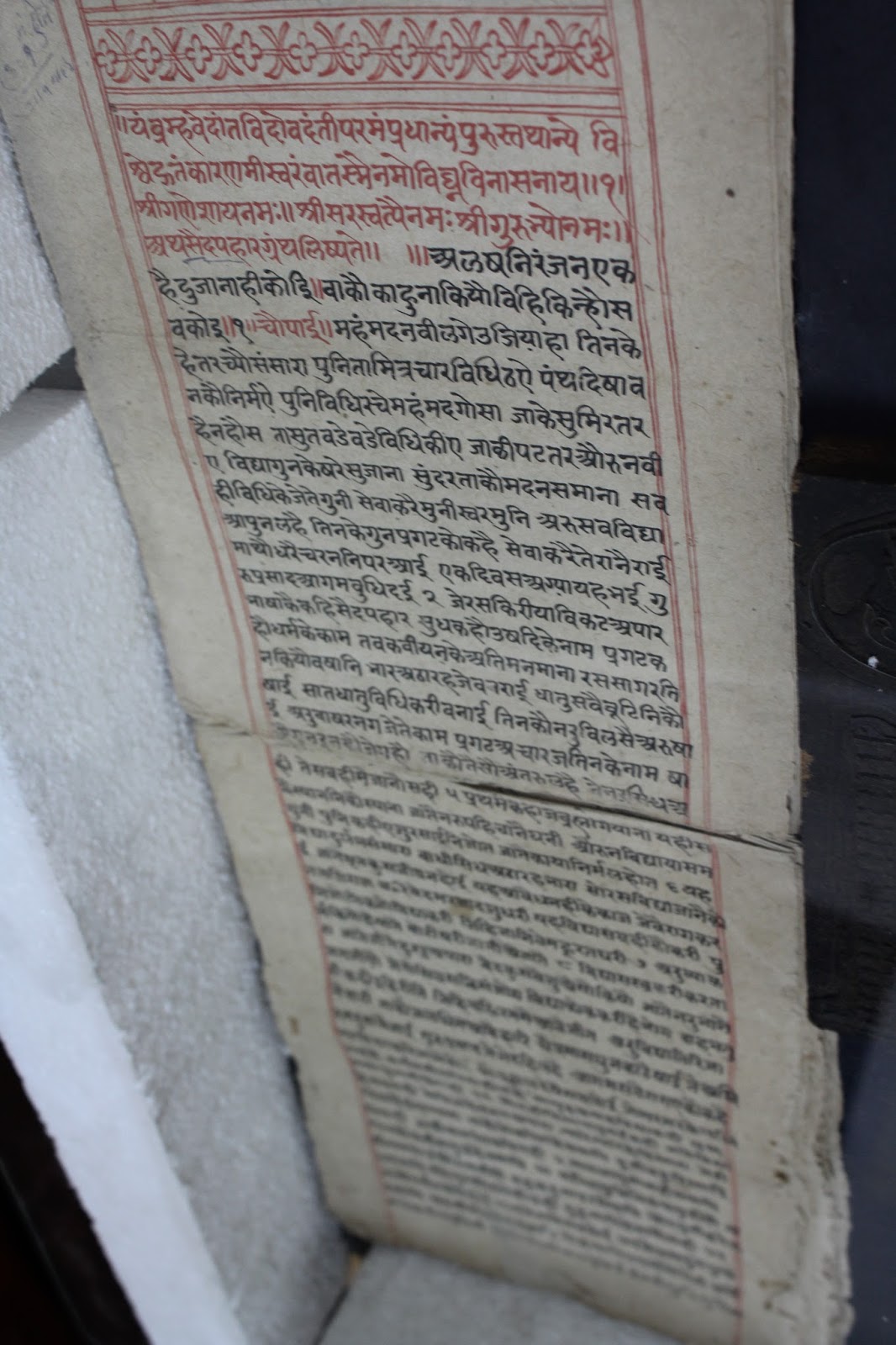
The Ground floor is the Manuscript section

13500 rare Manuscripts have been compiled which were  collected from all over India. The distinctive feature of these manuscripts is that they are all beautifully hand written. They number over one lakh and more.


Manuscripts

The pictures in these have natural colours. Rare as these manuscripts are, they have been treated with utmost care. So far digitization of all the manuscripts is complete. As new manuscripts are found, the work on their preservation continues.


It can be said that if any University or Math (рдорда ) from across India, ie. from Kanyakumari to the Himalayas need reference for the study of Dharma in Sanskrit, this is the right place to come. The Anand Ashram has the capability for providing books required for such studies. For just such a purpose 195 books have been published. 

The numbers speak for themselves. 13,500 hand written Manuscripts covering 26 different subjects. They range from "Alankar Sahitya, Kavya, Mahakavya, Laghukavya, Kavya Katha, Kavya Natak, Neeti, Nyaya, Purana, Ramayan, Mahabharat, The Geeta, Bhagwat Geeta, Dharmashastra, Smriti, Upanishads, Kaamshastra", the list is endless. All these are in Sanskrit. There is a huge demand for these from countries like Germany and others. A lot of foreign students come here to avail of the facilities provided for their research.


Markandeya Puran

Aside of this there is Jyotish Shastra and Board games.


The Digitisation of Manuscripts was completed with the help of The National Mission For Manuscripts.  

On the Second floor of the main building is the temple of Shiva. Festivals like Mahashivratri, Tripuri Poornima, Laghurudra Pooja are all held here.


Staircase leading to the temple


Doors open into the balcony

The Sabha Mandap

Shivling

View from the Balcony

The drops of water which fall on the Shivling, then fall on to the Paduka of Mahadev Chimaji Apte, whose Samadhi is on the ground floor in the Manuscripts department.

The Paduka

The Samadhi Sthal

As I visited the temple, I could hear a continuous recitation of Shlokas. After inquiring, I came to know that these were composed by Shankaracharya himself. I just sat there completely at peace while the shlok played on. Looking around the Sabha mandap, I noticed that each pillar had a different sculpture on it. The simple pillar was adorned with beautiful artistic work.


The Peacock

The Garud
To keep this structure intact and its Rare Literature rot free, the use of wood has been completely eliminated. The whole structure is in Stone and Iron.

The Ashram does not receive any grants from the Government. It solely runs on donations and rent from a bungalow on Sinhagad and on the interest of savings.
I was informed by the Administrator, Mr. Vasant Apte, that almost a Lakh of Rupees is spent only for the maintenance and upkeep of the Ashram.
The Ashram celebrated its 129th year on the 3rd of June this year. This 19th century marvel has remained intact and exactly as it was, those many years ago.

Before leaving I clicked some more pictures of this wonderful Ashram, vowing to myself that I will visit again.


Building at the entrance

Office Space

Top of the Temple

Coconut Palms


Courtesy:  Mr. Vasant Apte. Administrator. 
                   Mr. Vilas Salunke: excerpts from his translation
                   Mrs. Mane for showing me the manuscripts
                   Anand Ashram administrators for permission to take Photographs.