Battle of Panipat 1761

Battle of Panipat 1761

Pages

Thursday, June 30, 2016

Peek into AnandAshram

AnandAshram...Pune


Bajirao road at the Appa Balwant Chowk end is a busy one. Traffic snarls, honking vehicles, pedestrians walking, hand carts selling their wares, all find their niche here.

Nestled amongst all the shops and vendors lies an old structure which can easily be overlooked from the crowded street. Only if you stop in front of it can you see the facade of the building.


Anand Ashram

Inside, looking out of the Ashram


The Main  Gate

A huge gate beckons you to go inside. As you enter the portals, a calmness descends over you. Gone is the feeling of being in a rat race, of the need of being constantly on the move, of being continuously pressed for time. Time seems to stand still.

I remember visiting this place as a kid, with my Grandfather. Remember him explaining how illustrious this place was. As like most children, I had not given it much thought, forgetting about it, as I grew up. Recent conversations with my mother brought about the relation of Anand Ashram with me.

The famous Author of the time, Shree Hari Narayan Apte, lived here. It was here that he wrote books like: Pan Lakshaat Kon Gheto in 1890 which is considered a classic in Marathi fiction.  Jug He Ase Ahe (1901), Yashwantrao Khare (1906), Mi (1916), Ganpatrao (1919), Karmayog (1923), Mayecha Bajaar (1929), Bhayankar Divya (1930). These were however published in book form posthumously.

His first historical novel Mysore cha Waagh was based on Meadows Taylor’s “Tipu Sultan.” He then published historical novels like Gadh Aala Pan Sinha Gela (1904), Chandragupta (1905), Roopnagarchi Rajkanya (19009), Vajraaghaat (1915), Suryoday (1917), Kewal Swarajyaasathi (1918) Suryagrahan (1919). Although fictional, these novels exhibit his keen knowledge of historical details.


Hari Narayan Apte


Lodging of Hari Narayan Apte


His uncle and the founder of the Institution was Mahadev Chimaji Apte. A prominent lawyer, at the Bombay (Mumbai) High Court, who had fought the case of the freedom fighter Vasudev Balwant Phadke. The Institution was formed by him in 1885. Instead of distributing his wealth amongst relatives, he formed a Charitable trust, which is AnandAshram.

Mahadev Chimaji Apte

The Ashram has rooms for 20 students whose financial position is strained. Out of these, 8 to 10 students are admitted free of cost.

Hostel


Hostel Rooms

Aside of this, space is given for holding classes in the Sanskrit language. The main reason being the spread of the language which is slowly dying.

This is the 130th year of the Institution. In all these years there has not been a single day when work has stalled. Work on the spread of Sanskrit. Work on the preservation of rare manuscripts. Time consuming and taxing it is, but is carried on relentlessly by dedicated people. I spoke to Mrs. Mane, who was working on the Dnyaneshwari. the pride in which she showed me her work was to be seen to believe. 


Mrs. Mane


The Ground floor is the Manuscript section

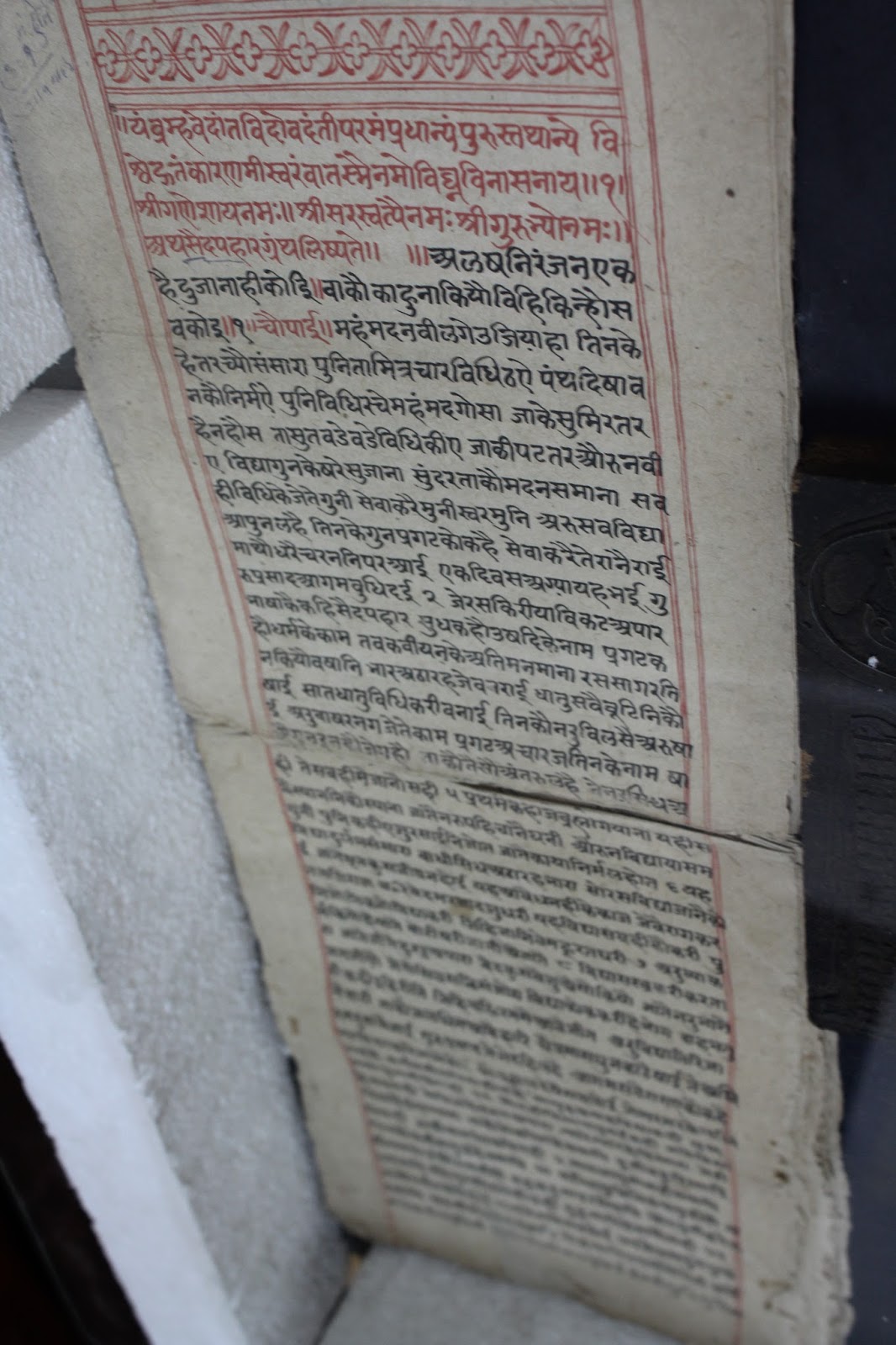
13500 rare Manuscripts have been compiled which were  collected from all over India. The distinctive feature of these manuscripts is that they are all beautifully hand written. They number over one lakh and more.


Manuscripts

The pictures in these have natural colours. Rare as these manuscripts are, they have been treated with utmost care. So far digitization of all the manuscripts is complete. As new manuscripts are found, the work on their preservation continues.


It can be said that if any University or Math (मठ ) from across India, ie. from Kanyakumari to the Himalayas need reference for the study of Dharma in Sanskrit, this is the right place to come. The Anand Ashram has the capability for providing books required for such studies. For just such a purpose 195 books have been published. 

The numbers speak for themselves. 13,500 hand written Manuscripts covering 26 different subjects. They range from "Alankar Sahitya, Kavya, Mahakavya, Laghukavya, Kavya Katha, Kavya Natak, Neeti, Nyaya, Purana, Ramayan, Mahabharat, The Geeta, Bhagwat Geeta, Dharmashastra, Smriti, Upanishads, Kaamshastra", the list is endless. All these are in Sanskrit. There is a huge demand for these from countries like Germany and others. A lot of foreign students come here to avail of the facilities provided for their research.


Markandeya Puran

Aside of this there is Jyotish Shastra and Board games.


The Digitisation of Manuscripts was completed with the help of The National Mission For Manuscripts.  

On the Second floor of the main building is the temple of Shiva. Festivals like Mahashivratri, Tripuri Poornima, Laghurudra Pooja are all held here.


Staircase leading to the temple


Doors open into the balcony

The Sabha Mandap

Shivling

View from the Balcony

The drops of water which fall on the Shivling, then fall on to the Paduka of Mahadev Chimaji Apte, whose Samadhi is on the ground floor in the Manuscripts department.

The Paduka

The Samadhi Sthal

As I visited the temple, I could hear a continuous recitation of Shlokas. After inquiring, I came to know that these were composed by Shankaracharya himself. I just sat there completely at peace while the shlok played on. Looking around the Sabha mandap, I noticed that each pillar had a different sculpture on it. The simple pillar was adorned with beautiful artistic work.


The Peacock

The Garud
To keep this structure intact and its Rare Literature rot free, the use of wood has been completely eliminated. The whole structure is in Stone and Iron.

The Ashram does not receive any grants from the Government. It solely runs on donations and rent from a bungalow on Sinhagad and on the interest of savings.
I was informed by the Administrator, Mr. Vasant Apte, that almost a Lakh of Rupees is spent only for the maintenance and upkeep of the Ashram.
The Ashram celebrated its 129th year on the 3rd of June this year. This 19th century marvel has remained intact and exactly as it was, those many years ago.

Before leaving I clicked some more pictures of this wonderful Ashram, vowing to myself that I will visit again.


Building at the entrance

Office Space

Top of the Temple

Coconut Palms


Courtesy:  Mr. Vasant Apte. Administrator. 
                   Mr. Vilas Salunke: excerpts from his translation
                   Mrs. Mane for showing me the manuscripts
                   Anand Ashram administrators for permission to take Photographs. 


Monday, February 29, 2016

Raviwar Peth Pune


Raivwar Peth
 Pune


A walk through the lanes of Raviwar Peth.

Darpana Athale and Vaibhavi Agarwal of Pune Walks, proposed this trip. I was in two minds about going, wondering what architecture we would find there. A mention of structures around 200 years old and I readily signed up for the walk.

Raviwar Peth at first glance is a maze of lanes and by lanes. The deeper you go, the more chances of you getting lost...or so I thought...


Going back into history, Pune was once known as Kasba and the Kasba Peth of today was a residential area, trade was carried out outside the Kasba. With the increase in commerce, traders from different regions came and settled on the outskirts of the kasba. These traders opened their shops and built their houses on top of the shops. Raviwar Peth boasts of being in existence since the 1600's.
The houses they built have a peculiar style. As shown in the photographs below, they are linear, that is they were narrow at the entrance and deep inside.


The shop is on the ground floor. The first floor is a meeting place to conduct business. the second and or third floor is the residence. Most of these structures open on to the road.
The area of Raviwar peth extends towards Shukrawar, Somwar and Budhwar peth. A Peth means a Bazaar or Market. So essentially all these peths are market areas.
Raviwar Peth is a wholesale market. It is divided into many parts. Each part boasts of a different trade. At the end of each part there is a temple almost like a demarcation point for the end and a beginning of a particular trade. Also some ancient masjids are seen here.
Raviwar Peth was known as Malkapur in the 16 and 1700's. Adilshahi, Nizamshahi, Shahaji Raje Bhosle, the Peshwa's and the British rule, has added a certain mix of Architecture and the business conducted here.
It is during the Peshwa rule that Raviwar Peth, as it came to be known, thrived as an affluent business centre.
Traders from different communities such as the Bohri's, Marwari's, Gujrathi's, Maharashtrians all came and set up their shops here. Living in perfect harmony, as they still do, we find remnants of their culture in their shops and living styles.
From hardware, Jewellery, Perfumes, Metal ware, Utensils etc. can be seen here. The names of the lanes or galli, in the Peth denote each area. There is Bhandi galli, Sugandhi Katta, Sarafa galli etc.


The Yevlekar and Dantale jewellers have been here since the 1800's. All jewellery in Gold, precious and semi precious stones was hand made. Infact today there is  only one Octogenarian gentleman, Mr. Bahulikar, who still makes hand made jewellery. This art will disappear unless it is revived again soon. Today all jewellery is mostly machine made.

Façades of buildings, some of which retain their original form, crumbling buildings with a few arches that remain intact tell us of the different types of architecture over the passage of time.
Here we find balconies, arches and windows, showcasing, art and architecture of the Mughal, Peshwa, Rajasthani and Colonial eras.


There are canopies and balustrades, intricately worked railings of balconies, in iron, cement and wood, crying out for attention.

Demolition work was being carried out to one of the structures and we could see the brick work, very different from what we see today. The bricks are square with a narrow width.These were known as 'Pustaki Veet', a brick shaped like a hard cover book. One such building had the year 1947 carved on it.


There are façades with a painted clock. Sadly the paint, has started peeling off through the ravages of time.
Most of these buildings today are in a dilapidated condition. With no maintenance and expensive to restore, they are either going to fall down or get demolished. Some of them, like the one shown below fall under the Development Plan of Pune and may be torn down.


New Modern Buildings will take their place. Box like structures with no grace or art will come up. This skyline is already mushrooming and the contrast is stark. Unfortunately in the coming decade these cement blocks will be our heritage.
It is heartening to see that students from VKPS College Of Architecture and MITID Architecture College are documenting these ancient structures for posterity.
The meticulous planning and execution of structures and the lanes of the 17th and 18th C., puts this haphazard and unplanned neo construction to shame. 
It is my personal opinion that each one of us should visit all the lanes and by lanes of our cities. The least we can do is to capture this legacy for the coming generations before it is too late.